Short answer
Argan oil is made by collecting the fruit, removing the pulp, cracking the hard nut by hand to free the kernels, roasting them for culinary oil, then grinding and pressing. Much of the work is done by women in cooperatives in southwestern Morocco, and it takes a lot of fruit to make a little oil.
Table of contents
- The tree and its fruit
- Collecting the fruit
- Drying and removing the pulp
- Cracking the nuts
- Roasting for culinary oil
- Grinding and pressing
- Settling and bottling
- How much fruit for how much oil
- The role of cooperatives
- Tradition and change
- Questions to ask on a visit
- A cooperative's year, in outline
- Hand and machine compared
- Words you will hear
- Why the process matters for your money
- Frequently asked questions
- Sources
- What we verified
Argan oil looks simple in a bottle. Making it takes many steps, and most of them are done by hand. Knowing the process helps you understand the price and ask better questions when you buy.
The tree and its fruit
The argan tree grows in the dry landscapes of southwestern Morocco. It is a tough tree with thorns, and it can live for a very long time. Its fruit looks a little like a large olive. Under a thin layer of pulp sits a very hard nut, and inside the nut are one to three small kernels.
Collecting the fruit
The fruit is gathered when it ripens, usually in summer. Many producers collect fruit that has fallen from the tree. You may see photographs of goats standing in argan trees, because goats do eat the fruit. Cooperatives that sell oil for people generally work with fruit gathered by hand. One popular history says that today the fruit is picked directly from the tree (Mental Floss).
Drying and removing the pulp
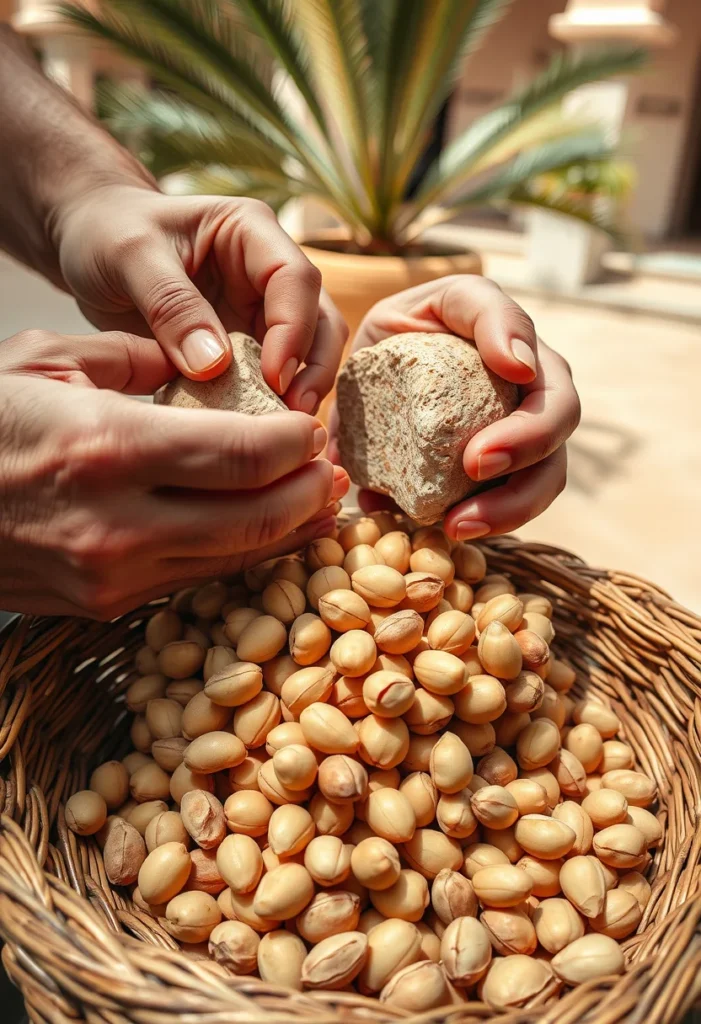
The fruit is left to dry, and the pulp is removed. The pulp is not wasted in a traditional household, since it is used as animal feed. What remains is the hard nut.
Cracking the nuts
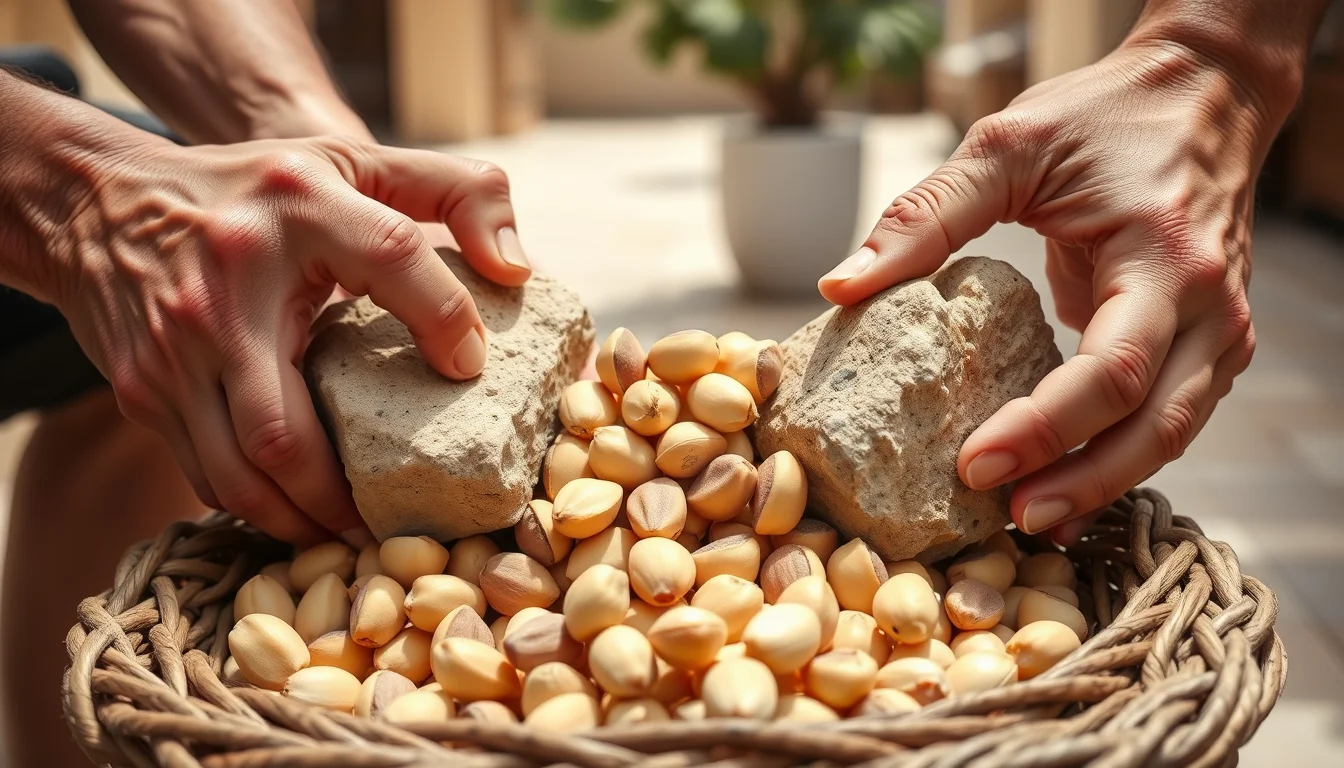
This is the slowest and most skilled step. A woman holds a nut against a flat stone and strikes it with another stone to break the shell and free the kernels without crushing them. Machines exist for this step, and many cooperatives still crack by hand. A skilled cracker works quickly, but the work is steady and repetitive.
Roasting for culinary oil
For culinary argan oil, the kernels are lightly roasted. The roasting gives the nutty, toasted aroma that Moroccan cooks know. For cosmetic oil, this step is skipped, so the oil stays pale and mild.
Grinding and pressing
Traditionally the kernels are ground on a stone hand mill into a paste. Water is added, and the paste is kneaded by hand until the oil separates. Many producers now use cold pressing machines that squeeze the oil from the kernels at a low temperature. Both methods can make good oil.
Settling and bottling
The oil is left to settle so that particles sink. It is then filtered or decanted and put into bottles or drums. Good producers label the batch and date, and they store the oil away from light.
How much fruit for how much oil
It takes a large amount of fruit to make a small quantity of oil. One popular account says about 250 pounds of fruit give 4 kilograms of kernels (Mental Floss), and a French report says it takes about 27 kilograms of fruit to make one litre of oil (Consoglobe, 2025). This is one reason why real argan oil is expensive.
The role of cooperatives
Women’s cooperatives have become a central part of the trade in the region. They provide a workplace, training and a shared market. Some cooperatives also pay higher wages than other local jobs, though this varies. WIPO reports that by 2010, women working in cooperatives earned about six euros a day, ten times more than before (WIPO). Ask any cooperative you visit how it pays its members and what it does with its profits.
Tradition and change
Older methods and modern machines exist side by side. A cooperative that uses an electric press can still work with fruit gathered by local women. A tourist workshop that stages a demonstration may sell oil made elsewhere. Ask where the oil in front of you was pressed.
Questions to ask on a visit
- Where does the fruit come from?
- Do you crack the nuts by hand?
- Do you press by hand or with a machine?
- When was this batch pressed?
- How many women work here, and how are they paid?
A cooperative’s year, in outline
The work of an argan cooperative follows the seasons.
| Stage | What happens |
|---|---|
| Summer | Fruit ripens and is gathered |
| Late summer and autumn | Fruit is dried and the pulp removed |
| Through the year | Nuts are cracked by hand or with machines |
| As orders come | Kernels are roasted for culinary oil, or kept raw for cosmetic oil |
| As orders come | Kernels are ground and pressed, and the oil settles and is bottled |
Hand and machine compared
| Step | By hand | With a machine |
|---|---|---|
| Cracking nuts | Slow, skilled work with two stones | Faster, with more broken kernels in some machines |
| Grinding | Stone hand mill | Electric grinder |
| Pressing | Kneading a paste with water | Cold press |
| Result | Often smaller batches | Larger, more consistent batches |
Neither approach is automatically better. What matters is the quality of the fruit, the temperature during pressing and the care in storage.
Words you will hear
- Argan, the tree and its fruit. Locally the tree is often called arjan in Arabic and Berber varieties.
- Kernel, the seed inside the nut.
- Cold pressing, extraction at a low temperature.
- Cooperative, a group of workers who share a workplace and profits.
Why the process matters for your money
Understanding each step helps you decide whether a price is reasonable. Cracking, roasting, grinding and pressing all take time, and a cooperative that pays fair wages has costs that a factory may not have. Ask about both, and remember that a high price alone is not proof of ethical production.
Frequently asked questions
Do goats really eat argan fruit?
Yes, goats eat it. Most oil for sale is produced from fruit gathered by people.
Is hand cracking better than machine cracking?
It preserves the tradition and the work, and it is slower. Quality depends on the whole process.
Why is argan oil more expensive than olive oil?
The work is slow and the yield is small.
Sources
- United Nations, how argan oil is made (un.org)
- Mental Floss, history of Morocco’s argan oil (mentalfloss.com)
- Consoglobe, argan oil (2025) (consoglobe.com)
- WIPO, the argan sector (wipo.int)
What we verified
Last checked: October 4, 2026
Sources:
- United Nations, how argan oil is made (un.org)
- Mental Floss, history of Morocco’s argan oil (mentalfloss.com)
- Consoglobe, argan oil (2025) (consoglobe.com)
- WIPO, the argan sector (wipo.int)