Short answer
Moroccan saffron vs Iranian saffron: which is better? Iran grows most of the world’s saffron, and Morocco grows a small share of it. We found no published head to head laboratory comparison of Moroccan and Iranian saffron, so we cannot say that one origin is better. What the evidence does show is that quality depends on the region, the harvest, and the handling, and that the cheapest way to judge a batch is its grade and its traceability, not the flag on the pack.
Table of contents
The two producers at a glance
| Point | Morocco | Iran |
|---|---|---|
| Production | 7.9 tonnes in 2024 on 2,400 hectares (Hespress, 2026) | 281 tonnes in 2021 (Nazarian and colleagues, 2024) |
| Share of world output | Small. Morocco ranked fourth in 2012 (Aramco World) | About 90 percent (Wikipedia) |
| Production cost | About double Iranian costs, above 20,000 dirhams per kilogram (Hespress, 2026) | Lower, according to the same report |
| Exports | Only about 5 percent of Moroccan output (same report) | The main supplier to the world market |
| Origin protection | Taliouine has PDO status and traceability to cooperative level (UVM workshop paper) | No published data |
The production years differ because we used the latest figure each source gave. The report on Morocco is from April 2026.
Does the origin decide the quality?
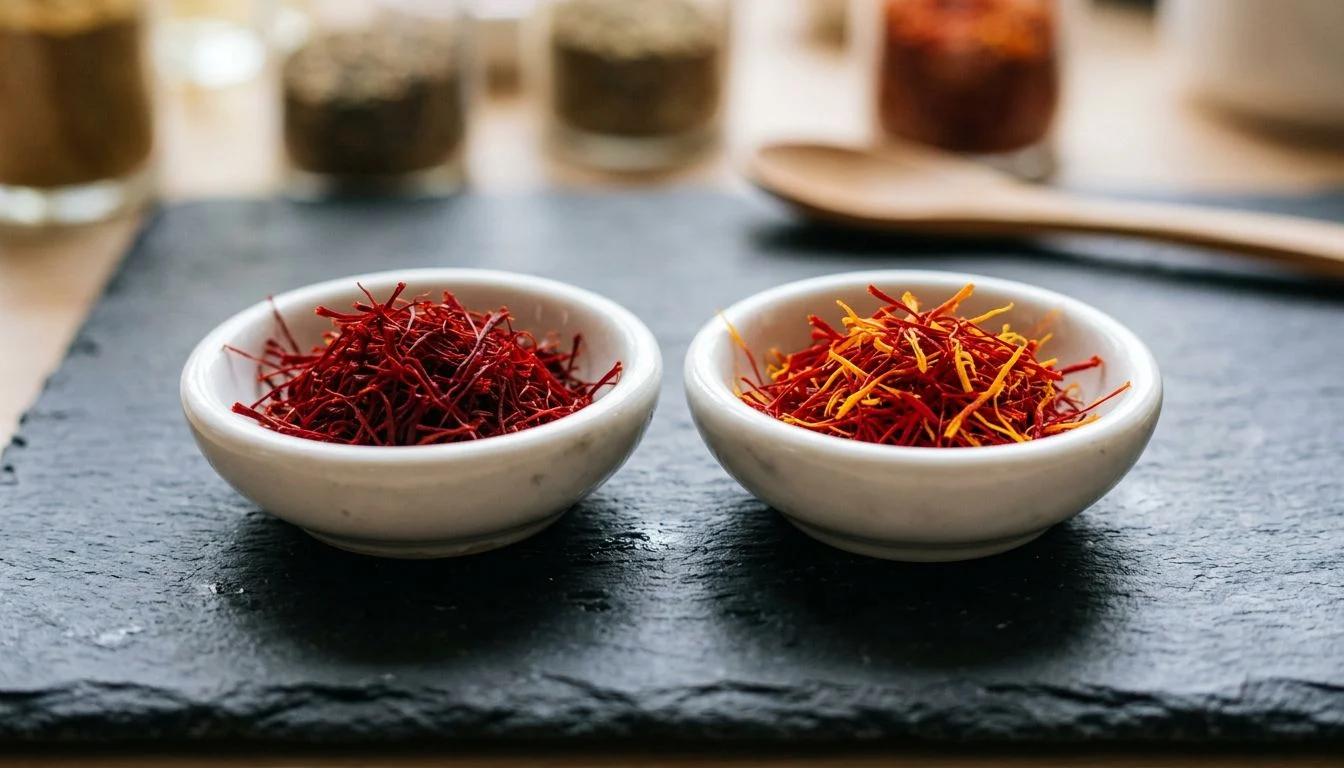
Both countries sell saffron graded under the international standard ISO 3632, which measures crocin for colour, picrocrocin for taste, and safranal for aroma. A grade I saffron from either country meets the same thresholds.
A 2024 study of saffron from Herat in Afghanistan and Torbat Heydarieh in Iran shows how much values can vary between regions. It measured an average colour value of about 279 in the Afghan samples and about 237 in the Iranian ones, and found that all samples but one reached the first grade (Nazarian and colleagues, 2024). The authors link the differences to local soil and climate. The lesson for buyers is that quality varies within a country as well as between countries.
For Taliouine, one French spice house describes certified organic saffron with notes of quince and honey and a hint of orange marmalade (Épices Roellinger). That is one seller’s tasting note and not a comparative test.
Why Moroccan saffron costs more to produce
According to Hespress, drought has cut Moroccan yields from 8 to 10 kilograms per hectare in 2010 to about 3 kilograms in 2020, and the harvest window has shortened to roughly 20 days. Together with high labour costs, this is why Moroccan saffron struggles to compete on price with imports, and why most of it is sold at home.
A warning about labels
An origin printed on a pack is not always where the saffron was grown. Aramco World reported that Spain, once the world leader, now imports saffron from Iran, Morocco, and Greece for repackaging and re export. A Spanish label can therefore hide a different origin. Look for the country of growth, the producer, and the harvest year, not only the packer.
Moroccan saffron vs Iranian saffron: how to choose
- Ask for the grade. A seller who can show an ISO 3632 category and a recent laboratory report is more trustworthy than one who relies on the country name.
- Prefer traceability. PDO Taliouine saffron can be traced to a cooperative and a producer.
- Buy threads, not powder. See our guide to real and fake saffron.
- Compare price per gram, and remember that a very low price suggests a problem whatever the origin. See our guide to saffron prices in Morocco.
- Match the saffron to the use. For a daily tagine, a good grade at a fair price is enough. Keep the finest threads for dishes where aroma matters.
Frequently asked questions
Is Iranian saffron better than Moroccan saffron?
There is no published head to head comparison, so neither origin can be called better. Grade, freshness, and storage matter more than the country alone.
Why is there so little Moroccan saffron on the world market?
Production is small, and Hespress reports that Morocco exports only around 5 percent of it.
Does Moroccan saffron have a protected label?
Yes, Taliouine saffron has Protected Designation of Origin status.
Sources
- Hespress, 2026 (en.hespress.com)
- Nazarian and colleagues, 2024 (oaj.fupress.net)
- Aramco World (archive.aramcoworld.com)
- Wikipedia (en.wikipedia.org)
- UVM workshop paper (uvm.edu)
- Épices Roellinger (epices-roellinger.com)